
Understanding Literacy Difficulties Beyond the Early Years
When people think about dyslexia, they often picture a young child struggling to recognise letters, sound out words or learn to read. While these difficulties can become noticeable during the early school years, dyslexia does not simply disappear when a child moves beyond primary school. For some children, literacy difficulties become more apparent as academic expectations increase. Others learn ways to cope with their challenges, making their difficulties less obvious to the people around them. Understanding this misconception is important because older children, teenagers and adults can still need appropriate literacy support.
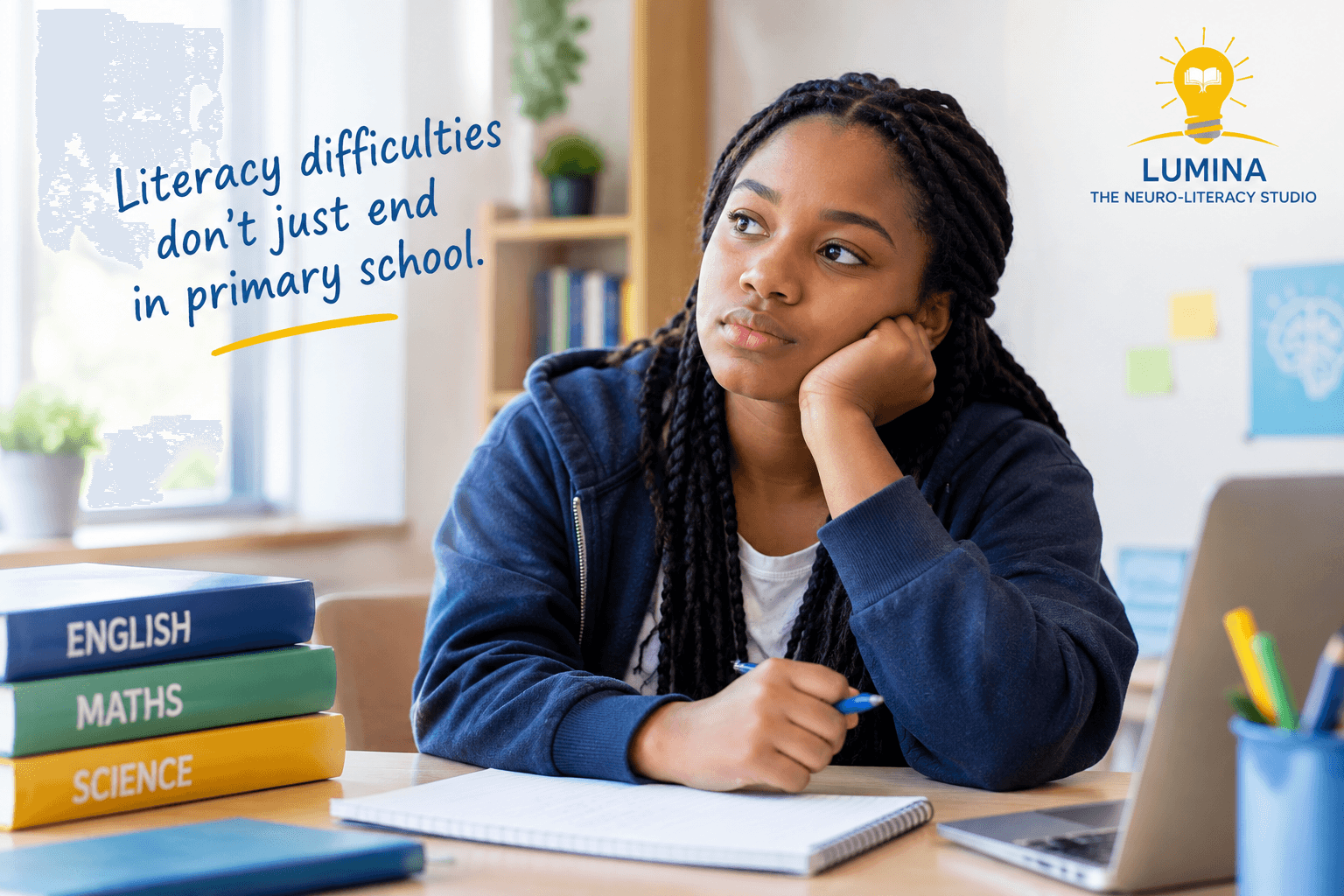
Why Dyslexia Can Become More Noticeable as Children Grow
In the early years of education, children are learning foundational literacy skills. As they progress through school, however, reading and writing become tools for learning almost every subject.
They may be expected to read longer passages, understand complex vocabulary, take notes, write extended answers and complete assignments within a limited time.
A learner who finds word recognition, spelling or reading fluency difficult may struggle to keep up with these demands, even when they understand the subject being taught.
For example, a teenager may understand a science topic perfectly well when it is explained verbally but struggle to read the textbook independently or express their knowledge in a written examination. The difficulty may not be a lack of understanding. It may be that reading and writing require considerably more effort for that learner.
Older Children Do Not Always Show the Same Signs as Younger Children
Dyslexia does not look identical in every learner, and its impact can change as academic demands increase.
An older child or teenager may: Take considerably longer than classmates to complete reading-heavy assignments. Find spelling difficult, even when they understand the meaning of the words they want to use.
Avoid reading aloud because they worry about making mistakes. Understand information when listening but struggle to access the same information independently through text.
Need more time to read, reread and understand written material.
Have difficulty organising written responses despite having good ideas.
These signs do not automatically mean a learner has dyslexia. Other factors can contribute to literacy difficulties, so persistent concerns deserve careful investigation rather than assumptions.
Can Dyslexia Be Supported Beyond Primary School?
Yes, appropriate support can help learners develop literacy skills and strategies that make reading and writing more manageable.
Older learners also benefit from understanding their own learning profile and having appropriate support in school, examinations and other learning environments.
The aim is not to make every learner progress in exactly the same way. It is to help them develop the skills and strategies they need to participate more confidently and independently.
What Parents and Teachers Can Do
If an older child or teenager continues to struggle with reading or written work, do not dismiss the difficulty simply because they are no longer in the early years of primary school.
Consider the patterns you observe. Does the learner understand information better when listening than when reading independently? Does written work take unusually long? Are spelling and reading difficulties affecting their ability to demonstrate what they know?
Share these observations with the child's school and seek an appropriate assessment or professional guidance where necessary.
Support does not become irrelevant because a child is older. In fact, recognising their needs as academic demands increase can make a meaningful difference.
Recognising literacy difficulties early can be helpful, but older learners should not be overlooked when they continue to need support.
At Lumina Neuro-literacy Studio, we believe that understanding a learner's individual needs is an important step towards meaningful literacy progress. Looking for dyslexia-informed literacy support for your child in Ireland? Book a free consultation with our literacy specialist to discuss your child's needs and explore appropriate next steps.
Ready to take the next step?
Every learner deserves the right support.
Book a free consultation with Lumina to discuss your child's needs and find the right path forward.
Book a consultationKeep Reading